Gisela Washington · 2 September 2026
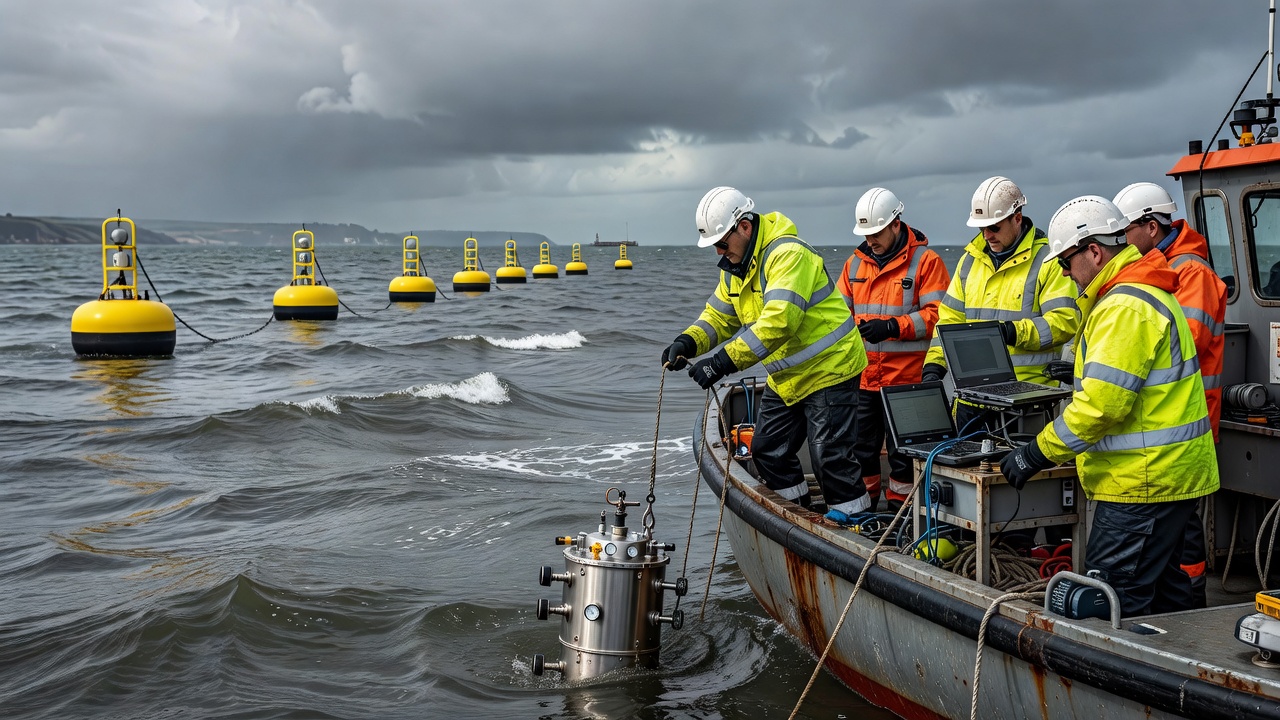
Quaylab Marine Research has completed installation of a new tidal monitoring array in the Bristol Channel. The system comprises twelve seabed-mounted sensors positioned across a 4-kilometre transect near the Severn Estuary entrance. Data streams began transmitting on 12 October and will run continuously for five years.
Technical Specifications and Deployment
Each unit records current velocity, turbulence intensity, salinity, temperature and suspended sediment at one-second intervals. Acoustic Doppler current profilers operate at 600 kHz while optical backscatter sensors measure turbidity. Power is supplied by titanium-encased lithium batteries rated for 60 months. Surface buoys relay compressed packets via Iridium satellite every fifteen minutes. Installation required three days of vessel time using dynamic positioning and remotely operated vehicles to secure frames against peak spring-tide flows exceeding 2.8 metres per second.
Calibration was performed against existing tide gauges at Avonmouth and Hinkley Point. Initial quality checks confirm 99.4 percent data availability with root-mean-square velocity errors below 3 centimetres per second. The array fills a recognised observational gap between the Welsh and English coasts where tidal asymmetry influences sediment transport and larval dispersal.
Research Applications and Expected Outcomes
Primary objectives include refinement of hydrodynamic models used for tidal-stream energy site selection. Improved boundary conditions will support predictions of array performance at proposed developments near the Bristol Channel. Secondary goals address coastal flood-risk mapping and long-term ecosystem monitoring under changing climate conditions. Partner institutions include the National Oceanography Centre and two universities conducting parallel benthic surveys.
Public data portals will release hourly averaged parameters within 48 hours of collection. Researchers anticipate the dataset will support at least fifteen peer-reviewed studies on tidal mixing, nutrient flux and fish migration corridors. Maintenance cruises are scheduled biannually to verify sensor drift and replace biofouling control cartridges. The project budget totals £2.7 million, funded through a combination of research council grants and industry contributions from marine-energy developers.